This guide breaks down how the two platforms actually differ, what each one costs, when to lean into one over the other, and why a lot of the best-performing marketing teams run both. We will also look at how to keep your reporting sane when you are juggling two ad accounts at once.
Short answer: Choose Google Ads when you want to capture existing demand and drive conversions from high-intent searchers. Choose Facebook Ads when you want to build awareness, reach a precise audience, and create demand with visual, scroll-stopping creative.
Most growing brands eventually use both: Facebook to fill the top of the funnel and Google to close at the bottom.
Facebook Ads vs Google Ads at a glance
Here is the quick comparison before we get into the detail.
Cost figures are illustrative cross-industry benchmarks. Actual numbers vary widely by industry, location, and competition.
The core difference: capturing demand vs creating it
The cleanest way to understand these two platforms is to think about demand.
Google Ads is a demand capture channel. Someone types "running shoes for flat feet" or "accounting software for small business," and your ad appears at the moment of intent. You are not convincing anyone they have a problem. They already know, and they are looking for a solution. That is why search ads tend to convert well and cost more per click. You are paying for intent.
Facebook Ads is a demand generation channel. Nobody opens Instagram or Facebook to buy something. They are there to scroll, watch, and connect. Your ad interrupts that scroll. The upside is enormous reach and pinpoint targeting based on who people are and what they care about. The trade-off is that you often need to warm people up before they convert, which is why social shines earlier in the funnel.

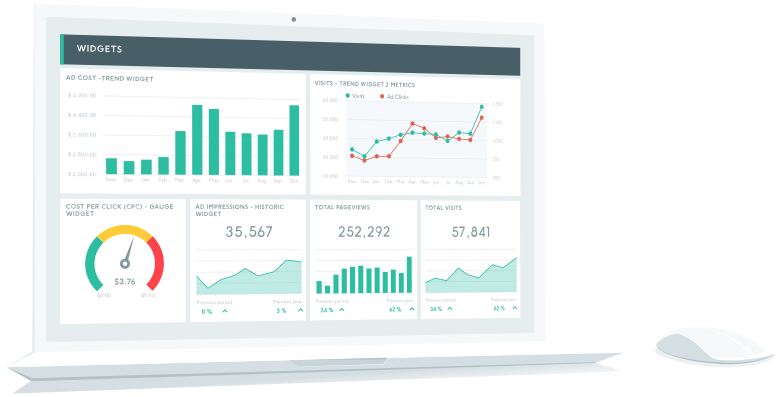
Try this dashboard with your data today
How they compare, head to head
Audience targeting
Google targets intent. You bid on keywords, then refine by location, device, time of day, and audience signals layered on top. The intent is doing most of the work.
Facebook targets identity. You can reach people by age, location, interests, life events, behaviors, and the pages they engage with. The real power tool is lookalike audiences, which find new people who resemble your best existing customers. If your product depends on reaching a very specific persona who is not actively searching, Meta's targeting is hard to beat.
Cost and CPC benchmarks
Clicks on Google Search usually cost more than clicks on Facebook because you are paying for intent. Competitive industries like legal, insurance, and finance can push search costs much higher, while Facebook clicks often stay well under two dollars. Cheaper clicks are not automatically better, though. A one dollar click that never converts is more expensive than a four dollar click that turns into a sale. Always judge cost against the outcome, not the click.
Reach and scale
Both platforms operate at staggering scale. Google processes billions of searches every day across Search, Maps, YouTube, and its display network. Meta reaches billions of daily users across Facebook, Instagram, Messenger, and the audience network. Neither one will run out of inventory for most advertisers. The difference is the context: Google reaches people in problem-solving mode, Meta reaches them in browsing mode.
Buyer intent and the funnel
This is the heart of the decision. Search intent is the single biggest reason Google Ads tends to convert at the bottom of the funnel. When someone searches "best CRM for agencies," they are close to a decision. On Facebook, that same person is watching a friend's vacation photos. You can still reach them, but you are introducing yourself rather than answering a question. That is why social tends to do its best work building awareness and nurturing interest, then handing warm prospects off to retargeting and search.
Ad formats and creative
Google leans on text-based search ads, Shopping ads for ecommerce, plus display and YouTube video for broader reach. The creative bar on search is more about message and relevance than visual polish. Facebook is a visual-first environment built around images, video, carousels, Reels, and Stories. Strong creative is not optional on Meta, it is the lever that makes or breaks performance. If you have great visual assets and a story to tell, social rewards you. If your strength is matching a precise query with a precise offer, search rewards you.
Measurement and attribution
Google Ads conversions are often easier to tie to revenue because the path is shorter and more direct: search, click, convert. Facebook conversions frequently happen across more touchpoints and over a longer window, so last-click attribution tends to undersell social's contribution. This matters when you compare the two side by side. If you only look at last-click conversions, Google will almost always look like the winner, even when Facebook did the early work that made the eventual search possible. Track assisted conversions and view-through impact, not just the final click.
When Google Ads is the better choice
Lean into Google Ads when:
- People are already searching for your product, service, or category.
- You need conversions or qualified leads quickly and have margin to support higher click costs.
- You sell something with clear, high commercial intent (emergency services, B2B software, local trades, ecommerce with branded demand).
- Your offer is easier to explain in a headline than in a visual.
- You want to capture competitor or category searches at the moment of decision.
When Facebook (Meta) Ads is the better choice
Lean into Facebook Ads when:
- Demand for your product does not exist yet, so you need to create it.
- You have a clearly defined audience persona but they are not actively searching.
- Your product is visual, lifestyle-driven, or benefits from storytelling and demonstration.
- You want lower-cost reach to build brand awareness and a retargeting pool.
- You are running a launch, a promotion, or content that thrives on engagement.
Why most winning strategies use both
Framing this as Facebook versus Google often leads marketers to the wrong question. The stronger play for most brands is Facebook and Google, each doing the job it does best.
A full-funnel flow usually looks like this. Facebook and Instagram introduce your brand to a precise audience and build a pool of people who have engaged. As those people start researching, they search on Google, where your search ads are waiting to capture them. Retargeting on both platforms keeps you top of mind for anyone who did not convert the first time. Each channel reinforces the other, and the combined result is almost always better than either one alone.
The catch is measurement. Running both means two ad accounts, two sets of metrics, and two definitions of success. To see the real picture, you need to look at performance across channels together, not in separate tabs. That is where a single reporting view becomes essential, which we will cover next.
4 trends shaping paid ads in 2026
A few shifts are worth keeping on your radar as you plan budgets.
- AI-driven campaign automation. Google's Performance Max and Demand Gen and Meta's Advantage+ now handle more of the targeting, bidding, and creative testing automatically. Your edge is shifting from manual knob-turning toward feeding the algorithms clean conversion data and strong creative.
- Privacy and signal loss. With tighter tracking restrictions and the slow fade of third-party cookies, both platforms are leaning on first-party data. Setting up server-side tracking, Google's Enhanced Conversions, and Meta's Conversions API is no longer optional if you want accurate reporting.
- The rise of AI search. AI Overviews and chat-based search are changing how people find answers, which nudges more budget toward branded search defense and toward social discovery higher in the funnel.
- Short-form video everywhere. Reels and YouTube Shorts keep growing, and video creative increasingly drives performance on both platforms. Static-only strategies are getting harder to scale.
How to measure Facebook Ads and Google Ads in one place
Once you are running both, the hardest part is not the ads. It is answering a simple question from a client or a boss: "How is everything performing?" When the answer lives in two dashboards with different metrics, you end up exporting spreadsheets and stitching numbers together by hand every week.
This is the problem DashThis was built to solve. It pulls your Google Ads and Facebook Ads data into one automated dashboard, side by side, so you can compare spend, clicks, cost per conversion, and ROI across both channels without touching a spreadsheet. If you report to clients, a clear cross-channel report also makes it obvious how the two platforms work together rather than against each other.
Getting started is quick:
- Connect your Google Ads and Facebook Ads accounts as data sources.
- Start from the PPC report template, which come preloaded with the metrics that matter.
- Drag in the widgets you care about, like cost per conversion, ROAS, click-through rate, and impressions.
- Set it to refresh and email automatically, so your report builds itself every week or month.
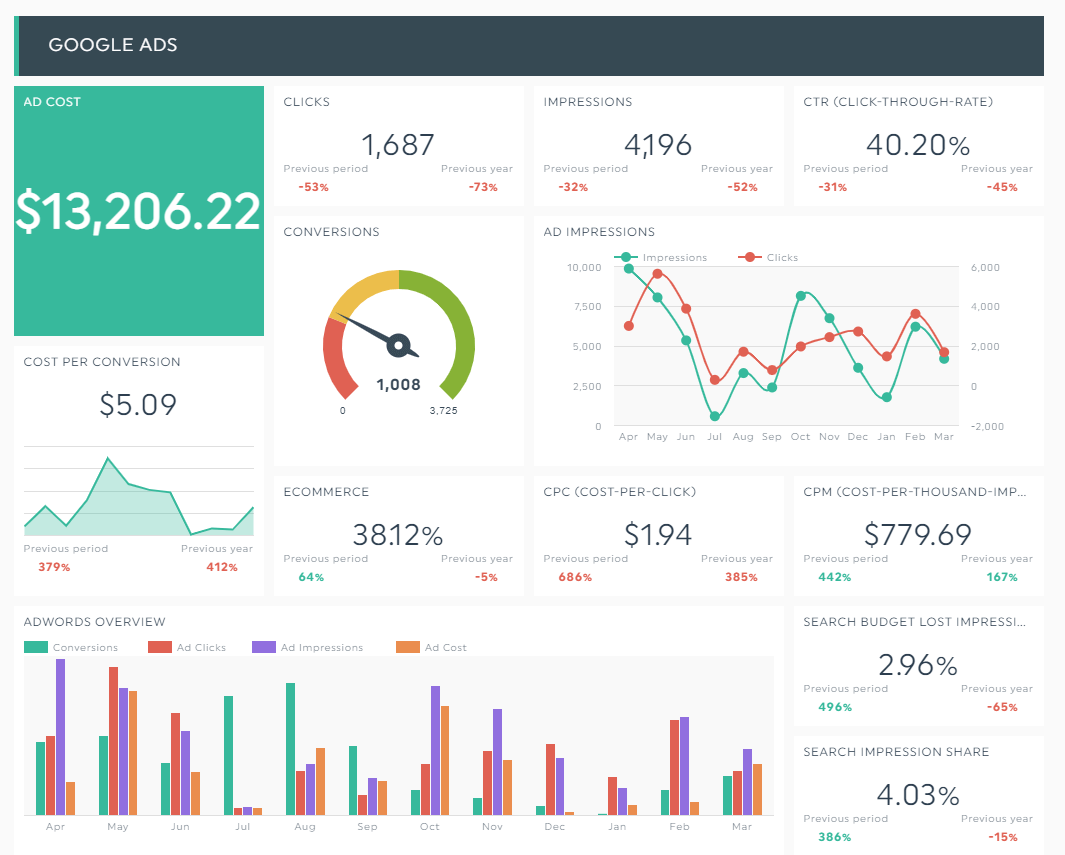
If you want to go deeper on the numbers themselves, it helps to know which Google Ads metrics actually matter, the PPC KPIs worth tracking, and how to read your conversion KPIs so a cheaper click never fools you into thinking a campaign is winning when it is not. For inspiration on layout, browse a few marketing dashboard templates.
The point is not to add another tool for its own sake. It is to get back the hours you would otherwise spend copying numbers, and to make better budget decisions because you can finally see Facebook and Google in the same view.
Frequently asked questions
The bottom line
Facebook Ads versus Google Ads is rarely a real either-or. Google Ads wins when you want to capture people who are already searching and ready to act. Facebook Ads wins when you want to reach the right audience and create demand before they search. Start with the channel that matches your immediate goal and budget, prove it out, then layer in the second to build a full-funnel engine. Whichever path you choose, measure both against real outcomes in one place so your next budget decision is based on the whole story, not half of it.